Japanese
Development of "Supramolecular Hybrid Materials"」
Many materials responsible for natural scientific phenomena are hybrids of organic (including polymeric) and inorganic substances. At Prof. Kuroiwa Laboratory, we observe natural phenomena from the perspective of atoms and molecules, use them as building units, and create hybrid nanomaterials by integrating multiple components.
Specifically, we utilize the spontaneous arrangement properties of amphiphilic compounds—such as self-assembly and interfacial activity—to organize diverse materials and develop nanoscale devices (biomimetic materials, electronic materials). Fundamental chemical concepts behind these studies include nano-ordering and metastable states.
To Students and High Schoolers Interested in Joining Our Laboratory
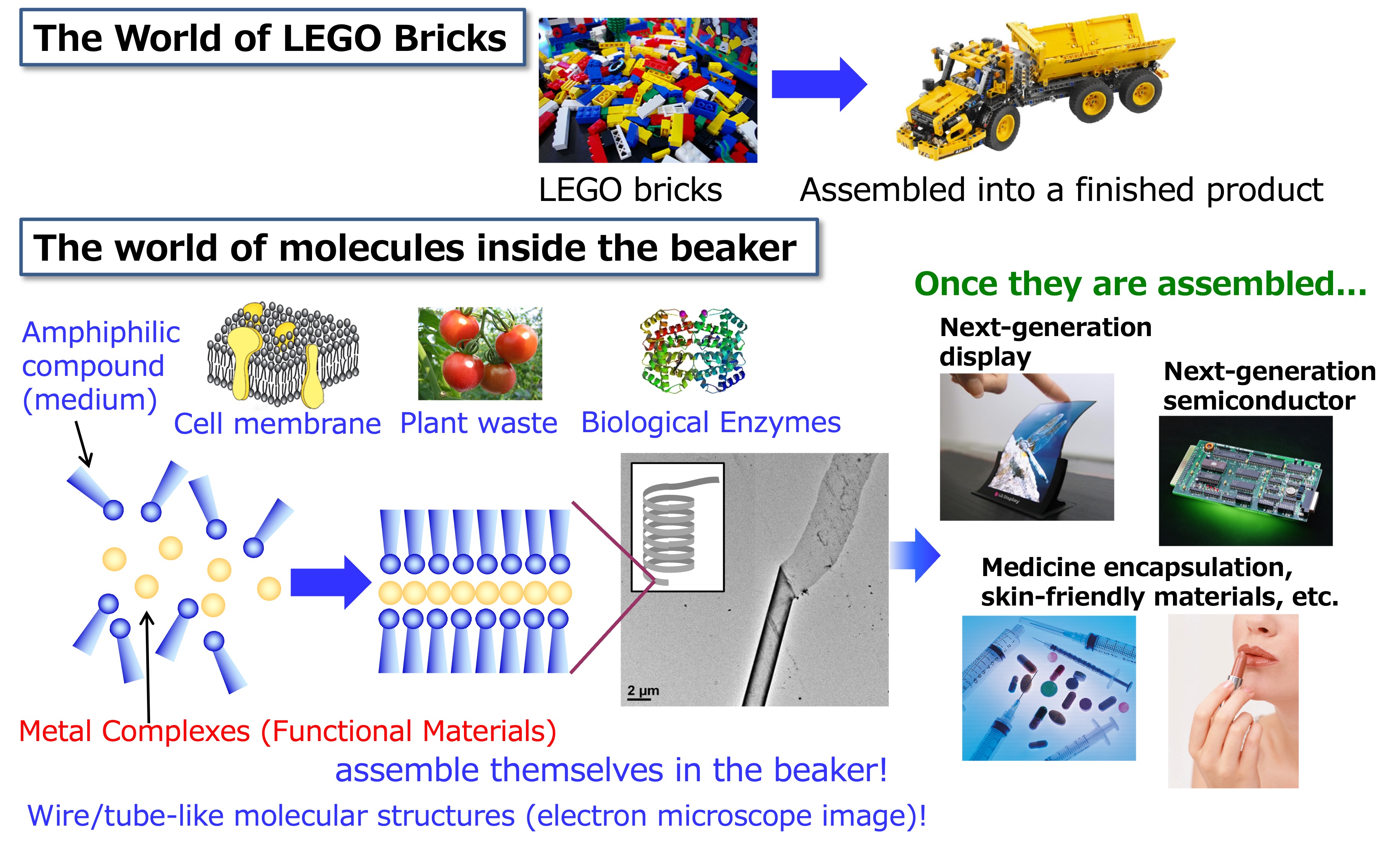
Supramolecular hybrids can be thought of as a type of LEGO play using molecular components, or like a Tetris game where seven shapes created from four squares must be arranged effectively. Our research aims to realize this concept in the nanoscale world. We provide a variety of conditions, analyze the resulting structures and properties, and continually refine the system—work that requires many collaborators.
Why not join us in exploring this interdisciplinary field?
Searching for Nano-Scale Building Blocks
— Creating Nano-Devices Inside a Beaker —
(Previously published public outreach articles)
“Laboratories that Create the Future,” Issue 4, Sojo University (May 2011)
Nikkan Kogyo Shimbun (Dec. 27, 2011)
Kagaku Shimbun (Jan. 13, 2012)
Kumamoto Nichinichi Shimbun (Apr. 23, 2012)
“Yumenavi” Academic Discovery Site (Oct. 19, 2013)
“Yumenavi” Academic Discovery Site (Oct. 17, 2015)
Buntoku Tenbyo 2018, 492 (66), 3
Kumamoto Nichinichi Shimbun (June 16, 2018)
Kagaku Shimbun (June 22, 2018)
Canon Foundation Research Newsletter (Oct. 26, 2022)
Manabi no Chizu”((Onjin Co.))(Apr. 8, 2025)
Creating Nano-Ordered Structures Inside a Beaker
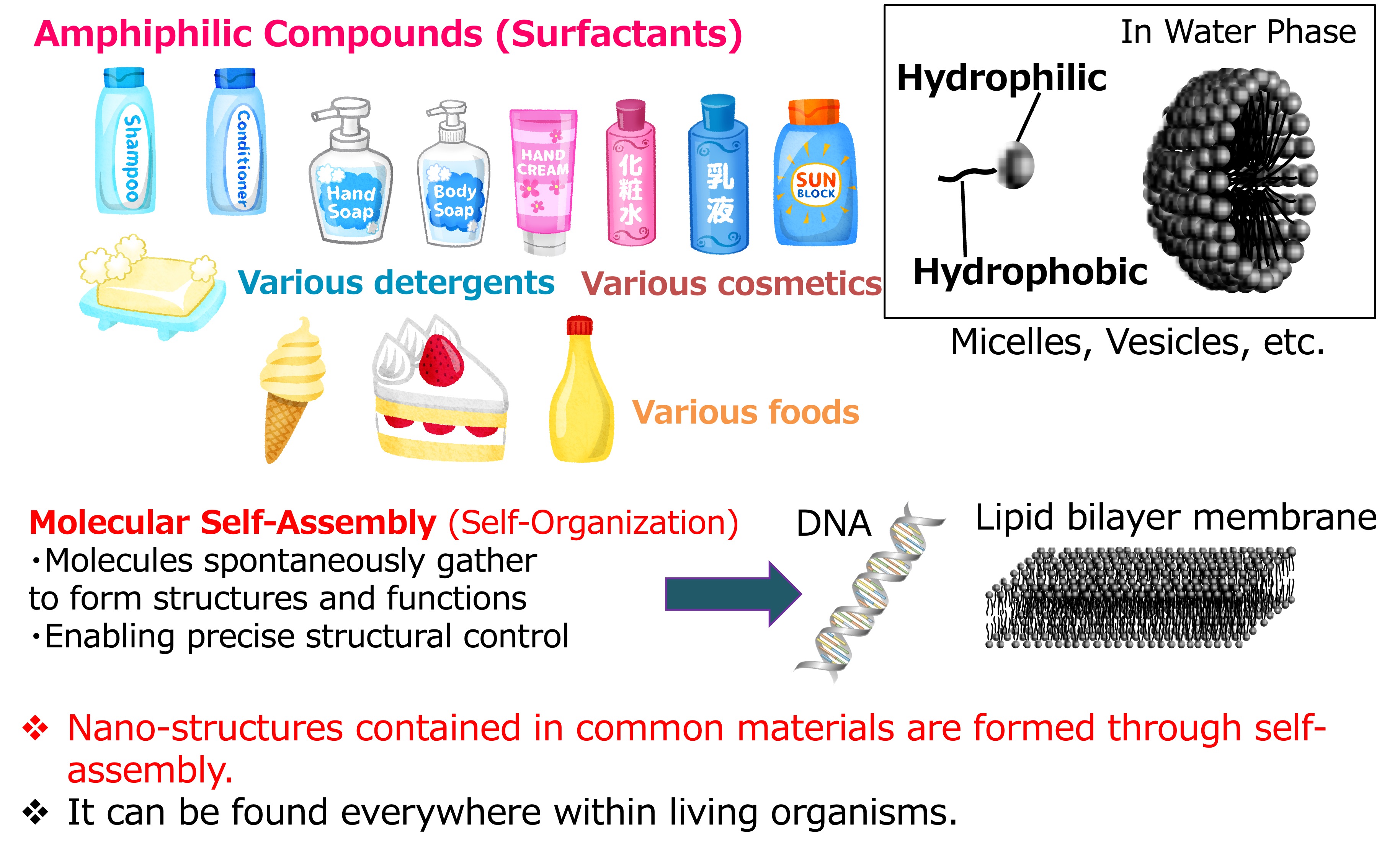
Soap and emulsifiers dissolve oils in water because each molecule possesses a part compatible with water and another compatible with oil. These molecules attach to the water–oil interface, enabling the two to mix. Substances that form such interfaces are commonly called surfactants, or more technically, amphiphilic compounds—“compounds that interact with both water and oil and mediate between them.”
These amphiphilic compounds are not only used in detergents and cosmetics but are also abundant in animals and plants as components of cell membranes, bioactive molecules, and proteins. Our current research theme involves manipulating these compounds inside a beaker and inducing their self-assembly.
We mix materials thought to possess conductivity, magnetism, luminescence, or bioactivity (e.g., metal complexes) with amphiphilic compounds to create innovative building blocks and ordered nano-structures. To analyze the resulting shapes and properties—formed at the 10⁻⁷ cm scale—we use high-precision analytical instruments. Yet, the “factory” creating these nanoarchitectures is nothing more than a single beaker.
Smart Transformation Driven by Molecular “Encounters”
Possible morphologies include sheets and three-dimensional assemblies, but we first focus on fibers and thin sheets, which are easier to characterize with electron microscopy. Through repeated experiments, we discovered something intriguing:
When various amphiphilic compounds—ranging from small molecules to polymers—encounter inorganic compounds such as metal complexes or metal clusters, they form beneficial hybrids that enhance material performance. Moreover, the atoms and electrons within these substances appear to “communicate” appropriately with one another, selecting arrangements that optimize magnetic, luminescent, or catalytic properties.
While “communication between electrons” may sound humorous, changes in electron distribution around an atomic nucleus directly alter magnetic, conductive, and luminescent properties. Thus, certain combinations can enhance one another synergistically.
Through collaboration with mentors and colleagues, we succeeded in controlling the arrangement of nanoscale metal complexes. Inspiration came from biological systems—brain tissue and cell membranes—because living organisms have evolved to select the most efficient molecular arrangements. Instead of imposing artificial designs, allowing atoms and molecules to self-select optimal arrangements leads to more functional, flexible materials with broader applications.
We now evaluate conductivity, magnetic memory, luminescence, bio-labeling properties, and pharmacological activity of these nanoarchitectures. Countless further experiments and engineering challenges await us on the path toward practical applications.
Representative Research Examples
Hybrids with Proteins from Habu Snake Venom
In this study, we successfully transformed phospholipase A2 extracted from Habu snake venom—known for its potent toxicity—into nanomaterials by focusing on its unique surface structure. Although many types of venom-derived phospholipase A2 exist, each with characteristic toxicity, we identified methods for hybridization with metal complexes.
These hybrids form fibrous or rod-like structures and exhibit luminescent properties unique to their nano-organized states. By controlling the assembled structures, applications such as transforming “toxin → therapeutic agent,” regulating bioactivity, or using the materials as bio-labels are envisioned.
This research integrates structural simulations using AlphaFold2 and surface analysis using PyMOL, correlating computational insights with experimental results.
A collaborative project with Prof. Naoko Oda-Ueda (Faculty of Pharmaceutical Sciences, Sojo University).
Kuroiwa, Keita*; Matsumura, Yusei; Nagano, Keito; Kishimoto, Reina; Yoshizawa, Mai; Fujimura, Aoi; Shimaki, Nobuhito; Sakuragi, Mina; Oda-Ueda, Naoko,
"Supramolecular hybrids of proteins from Habu snake venom with discrete [Pt(CN)4]2- complex. ",
ACS Applied Materials & Interfaces 2024,16 (46), 63884-63893. DOI:10.1021/acsami.4c09837
Selected to feature on the Front Cover Picture
Hybrids with Terpenoid Glycosides
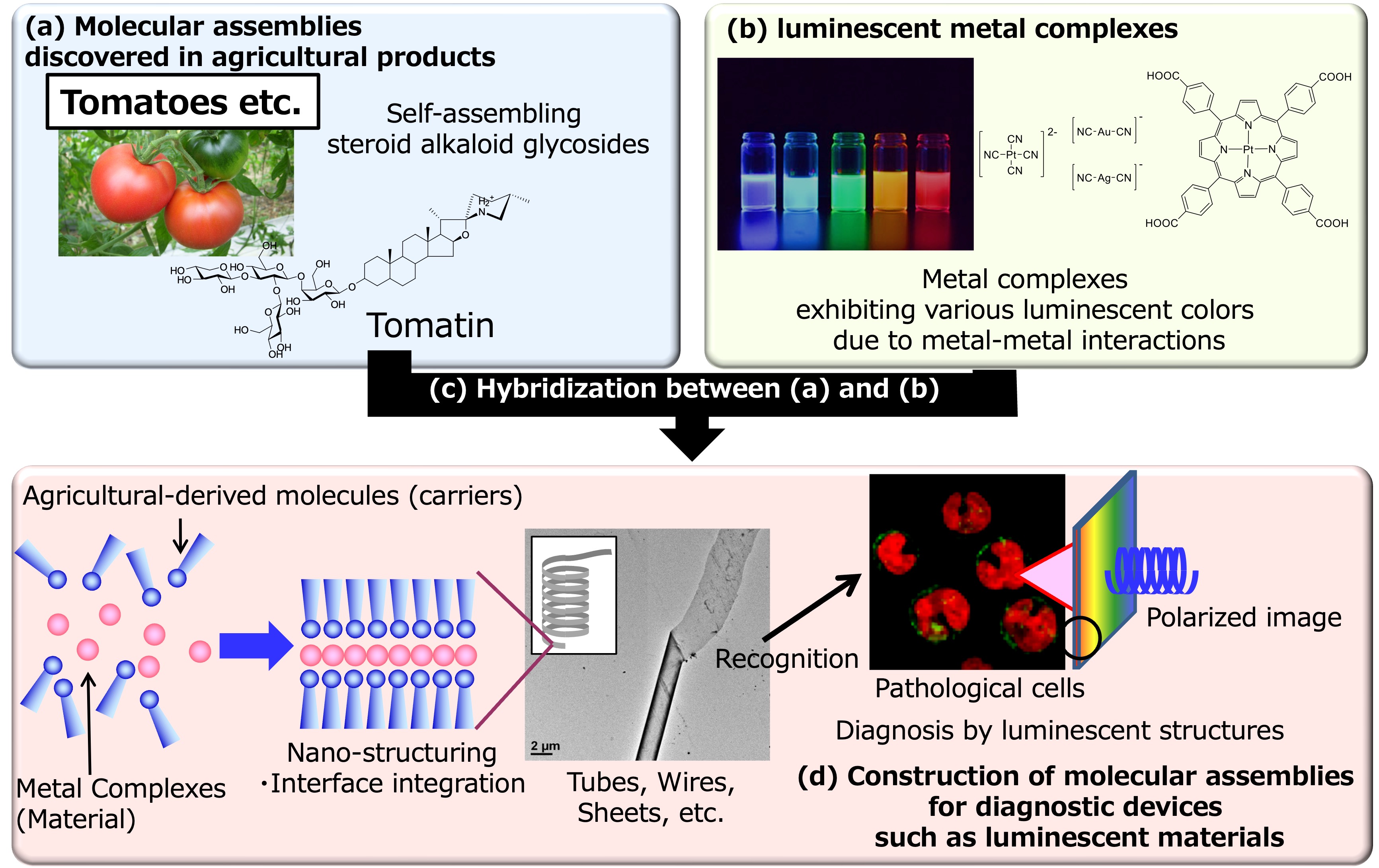
We also transformed terpenoid glycosides—such as tomatine and dehydrotomatine from tomato leaves/stems and glycyrrhetinic acid glycosides from licorice—into nanomaterials. By integrating the search for amphiphilic compounds from agricultural sources with the development of molecularly organized photofunctional materials, we generated agro-industrial hybrid nanomaterials.These hybrids form nanotubes and nanosheets and exhibit luminescent and magnetic properties unique to their assembled states. Tomatine derivatives possess natural biological functions (e.g., LDL cholesterol reduction, anti-foaming effects), making them promising candidates for bio-labeling.
By combining them with various metal complexes, we not only created nanostructures but also demonstrated selective cytotoxicity toward cancer cells and photodynamic activity. This approach may be considered an upcycling of agricultural waste.
Keita Kuroiwa*, Kouta Araki, Rara Naito, Sangeetha Srinivasa Shetty, Yasuhito Koyama, Shinya Hayami,
"Fibrous/Sheet Nanostructures of Spin-Crossover Complexes With Glycyrrhetinic Acid Glycosides in Polar Solvents: Supramolecular Control of Mixed HS/LS State. ",
Chem. Eur. J. 2026, , in press. DOI:10.1002/chem.71111
Mayuko Fujitsuka, Daisuke Iohara, Sae Oumura, Misaki Matsushima, Mina Sakuragi, Makoto Anraku, Tsuyoshi Ikeda, Fumitoshi Hirayama, Keita Kuroiwa*,
"Supramolecular assembly of hybrid Pt(II) porphyrin/ tomatine analogues with different nanostructures and cytotoxic activities. ",
ACS Omega 2021,6 (20), 13284-13292. DOI:10.1021/acsomega.1c01239
Selected to feature on the Front Cover Picture
Mayuko Fujitsuka, Kouta Araki, Tatsuhiro Kodama, Tran Thi Dieu Hien, Mina Sakuragi, Sangeetha Shetty, Yasuhito Koyama, Keita Kuroiwa*,
"Supramolecular control of spin equilibrium and oxidation state in nanohybrids of amphiphilic glycyrrhetinic acid derivatives with [Fe(TACN)2]2+. ",
Chem. Lett. 2021, 50 (6), 1142-1145. DOI: 10.1246/cl.210083
X(Twitter)
Souta Toohara, Yasuaki Tanaka, Shinichi Sakurai, Tsuyoshi Ikeda, Kazuo Tanaka, Masayuki Gon, Yoshiki Chujo, Keita Kuroiwa*,
Chem. Lett. 2018, 47 (8), 1010-1013. DOI: 10.1246/cl.180320
Kumamoto Nichinichi Shinbun (2018.6.16), Kagaku Shinbun (2018.06.22)
Hybrids with Amphiphilic Block Copolypeptides
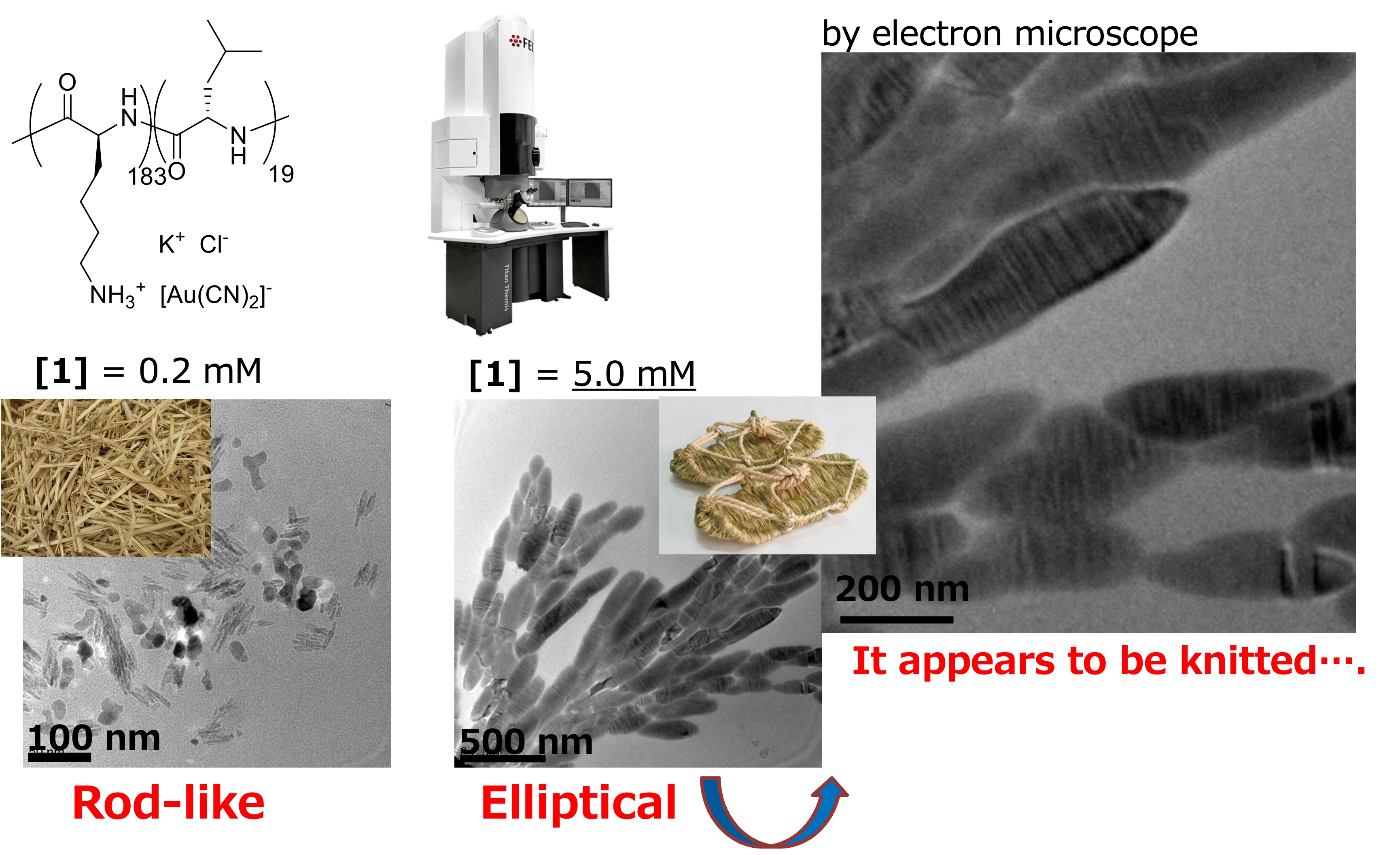
In the field of nano metal complexes built from metal–ligand coordination, advanced studies are being conducted on metal proteins, enzymes, and supramolecular complexes. Metal proteins achieve functional switching (induced-fit, allosterism) by surrounding metal complexes with sophisticated polypeptide environments. However, artificially reproducing such complexity with synthetic polypeptides is extremely challenging.In contrast, amphiphilic block copolypeptides, despite having simple amino acid sequences, can form fibers, vesicles, sheets, and other morphologies. When hybridized with metal complexes, they may even form higher-order structures reminiscent of metal proteins.
Our research has succeeded in creating well-defined nano-shoes (Japanese Waraji), nanobricks, nanocushions, and other sub-nanometer architectures by forming molecularly organized hybrids of block copolypeptides with metal complexes. These materials exhibit luminescent, magnetic, and catalytic functions as nanoscale components.
Keita Kuroiwa*, Touka Tada; Miki Ichise; Shigeyuki Masaoka,
Supramolecular hybrid of Fe pentanuclear complex/diblock copolypeptide amphiphiles with pH-responsive nano/microstructures in water,
Mater. Adv. 2026,7 (4), 2039-2046. DOI: 10.1039/d5ma01393c
Selected to feature on the Back Cover Picture
Keita Kuroiwa*, Yuya Tanimura, Mengfei Wang, Mitsuhiko Morisue, Yasuchika Hasegawa,
Diblock Copolypeptide Amphiphiles-Mediated Assembly and Structural Modulation of Porphyrin Dimers in Aqueous Media,
Langmuir 2026,42 (1), 597-608. DOI: 10.1021/acs.langmuir.5c04712
Selected to feature on the Supplemenatry Cover Picture
Yuya Tanimura, Kaito Miyamoto, Takuya Shiga, Masayuki Nihei, Keita Kuroiwa*,
"Supramolecular Control of Magnetism and Morphology of Hybrid Diblock Copolypeptide Amphiphile/Cyanide-Bridged Molecular Square Complexes. ",
J. Phys. Chem. C 2023,127 (33), 16525-16537. DOI: 10.1021/acs.jpcc.3c03898
Selected to feature on the Front Cover Picture
Yuya Tanimura, Mina Sakuragi, Timothy J. Deming, Keita Kuroiwa*,
"Self-assembly of Soluble Nanoarchitecture using Hybrids of Diblock Copolypeptide Amphiphiles with Copper Rubeanate Hydrates in Water and Their Electrooxidation Reaction. ",
ChemNanoMat 2020,6 (11), 1635-1640. DOI: 10.1002/cnma.202000481
Selected to feature on the Front Cover Picture
Arie Tsubasa, Soichi Otsuka, Takahiro Maekawa, Ryota Takano, Shinichi Sakurai, Timothy J. Deming, Keita Kuroiwa*,
Polymer 2017, 128(16), 347-355. DOI: 10.1016/j.polymer.2016.12.079
Special Issue "Supremolecular polymers"
Keita Kuroiwa*, Tsubasa Arie, Shinichi Sakurai, Shinya Hayami, Timothy J. Deming ,
J. Mater. Chem. C 2015, 3 (30), 7779-7783 DOI: 10.1039/c5tc00677e
Thermed Issue "Spin-State switches in Molecular Materials Chemistry"
Highlighted as a Front Cover Picture Selected as a Hot Paper 2015
This work has also been featured in Kobunshi (The Society of Polymer Science, Japan) as a “Hot Topics” article.高分子」
Yoshitaka Masaki, Satoru Nakahara, Yuko Koga, Keita Kuroiwa
Hot Topics "Self-Assembly of Discrete Metal Complexes Integrated by Block Copolypeptide Amphiphiles in Water"
Kobunshi, 2012, 61, (1), 5